
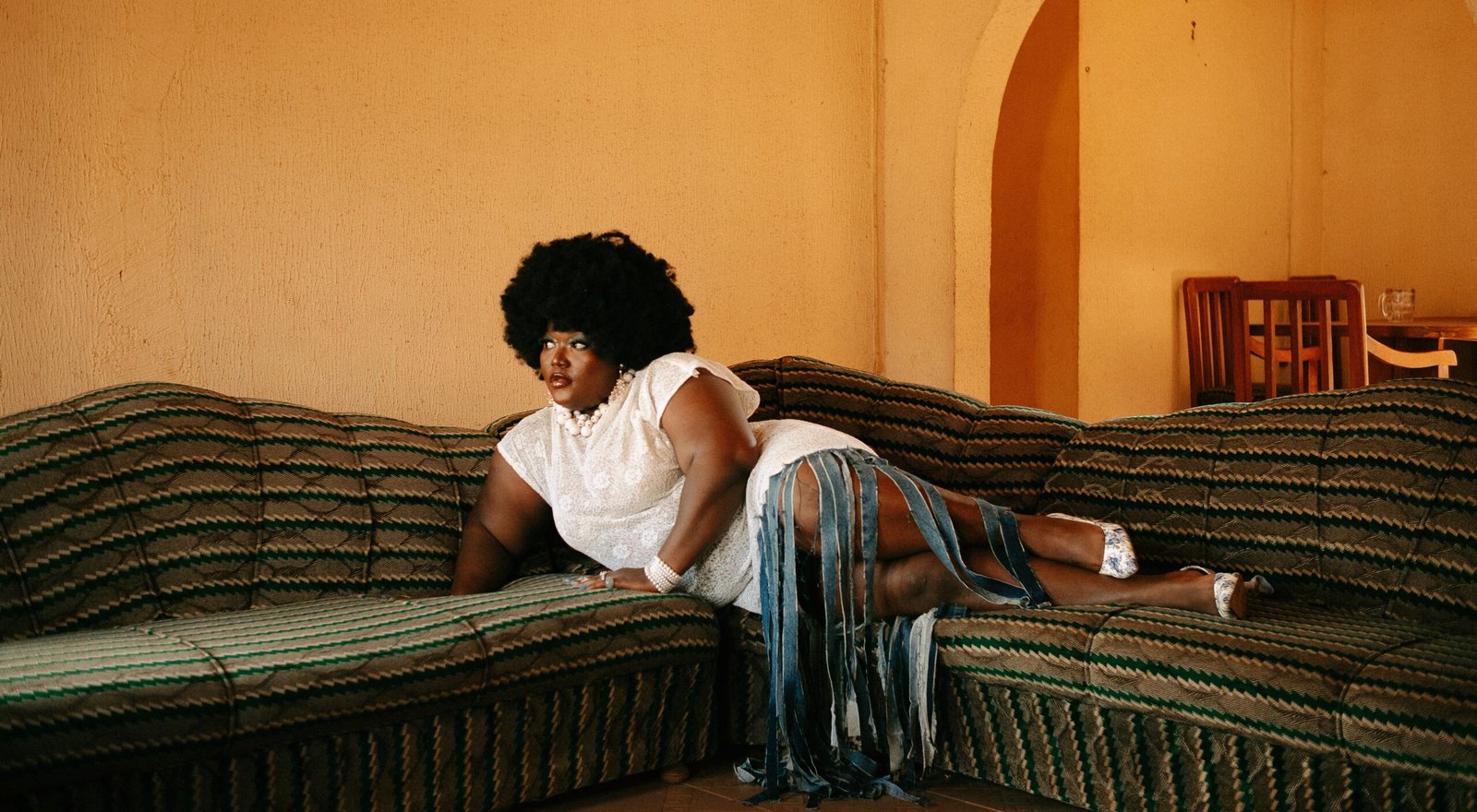
Her striking images have appeared in fashion magazines like Vogue, but Alexandra Obochi says bringing LGBTQ+ Nigerians into focus is part of a much broader effort to ‘confront the patriarchy’ through art.
by Daniel Anthony
Living openly as a queer person in Nigeria means learning all too quickly how visibility shapes the way you navigate the world. For creatives channelling their identity through their work, that often means treading carefully through hostile terrain without letting fear define them. Photographer Alexandra Obochi knows what it feels like to walk that fine line.
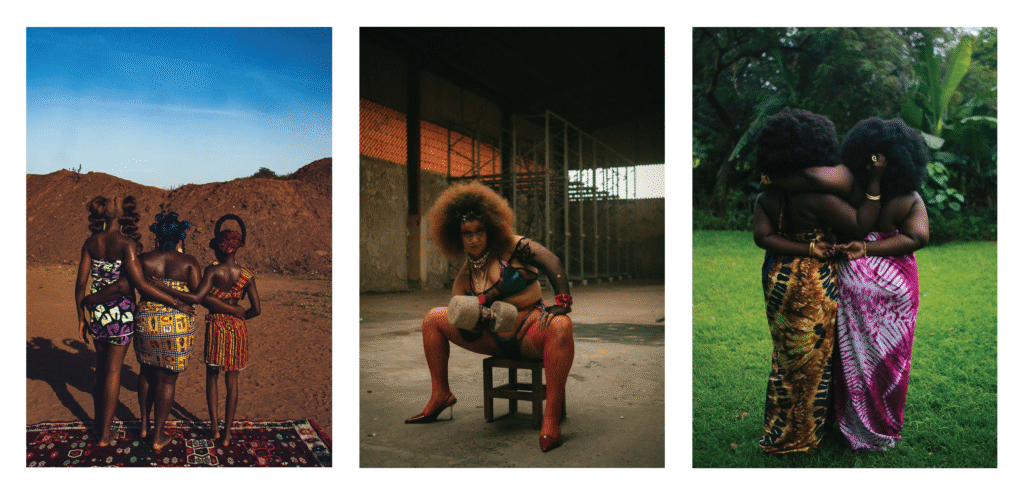
At 27, Obochi has already made waves for her arresting imagery. Appearing in international magazines like Vogue and Dazed as well as local titles such as The Native, her stylised photos spotlight the bodies and identities pushed to the margins of Nigerian society, including LGBTQ people. A tenderness and confidence run through much of her work, shaping explorations of femininity, softness and queerness in ways that feel both intimate and nuanced.
Whether in magazine pages or on her own platforms, Obochi has never hidden her identity as a queer woman. Indeed, she has often foregrounded it. “Because I’m queer, I’m not bound by heteronormativity and the ideals of patriarchy,” says the self-taught photographer who lives and works in Abuja. “This allows me to explore the world and my work through different perspectives. My queerness doesn’t limit what I can do; I can expand in any direction I choose.”
There’s something kinetic about the way Obochi discusses creativity. Even in conversation, her thoughts seem to move faster than the sentences that express them. She laughs frequently, circles back to previous ideas, and speaks about the visual arts as if it’s not just a profession but something that’s almost inseparable from her sense of self.
“Even though it doesn’t always work out, I keep coming back for more,” she says with a chuckle, referring to the photo shoots and multidisciplinary events she creates around fashion, makeup and styling. “That’s how I know I’m a little crazy.”
Living Boldly
Obochi is one of a small but increasingly visible group of Nigerians working in the creative industries who are openly LGBTQ. For admirers, the appeal of their work lies not only in its substance, but in the sense of possibility they represent.
Bolaji, a friend and fan of Obochi’s photography, describes her as someone who lives life with striking openness despite the pressures of being out in Nigeria. “When I look at Alexandra,” he says, “I see someone who is living boldly.”
Obochi’s visibility carries significance beyond the LGBTQ and plus-size communities. Bolaji describes her as “an embodiment of hope” for others who face exclusion because of who they are.
Besides her eye-catching imagery and distinct perspective, what sets Obochi apart is her refusal to internalise any shame in a country that remains deeply hostile to LGBTQ people.
“I have never hated or resented myself for being queer. I have learned to embrace that part of myself [even though] people are very judgmental and very bigoted when it comes to identity and expression,” says Obochi. “It’s a heavily traditional society, so anything that doesn’t fit into the customs they’re used to becomes opposed.”
But the opposition facing sexual and gender minorities in Nigeria can extend beyond everyday experiences of social stigma and safety risks. It can also carry severe legal consequences.
Consensual same-sex sexual activity in Nigeria is punishable by up to 14 years’ imprisonment for both men and women under federal law. In some northern states applying religious Sharia law, punishments can range from flogging for gender non-conforming offences to the death penalty for certain same-sex acts. Since 2013, the Same-Sex Marriage Prohibition Act has further tightened restrictions around LGBTQ organising, visibility and public expression in the country.
In places where LGBTQ people are criminalised, being open about one’s identity often requires careful and constant negotiation within families and social circles. Obochi experienced that first-hand when she was outed to her parents without her consent, forcing her to leave home briefly while tensions eased.
“Being outed to my family was such an unpleasant ordeal that left me feeling violated,” she says quietly. “I was still basically a teenager, trying to figure out and embrace my sexuality when it happened. The outing disrupted that process completely, and I ended up leaving home for over a week.”
According to Obochi, her parents eventually came to accept her sexuality after she returned home, but only on the condition that she remained discreet about it. Although she describes her relationship with her family as loving and supportive, she also understands that acceptance comes with boundaries.
Even within Nigeria’s creative communities, some of which are considered more welcoming to LGBTQ people than wider society, unwritten social codes around visibility continue to shape how openly people live and express themselves.
Obochi is also aware that her experience differs from that of other LGBTQ Nigerians. “I could easily pass as a straight woman,” she observes. That relative invisibility, she suggests, has likely protected her from some of the harsher realities faced by more visibly gender non-conforming people.
However, instead of fading into that invisibility, she has increasingly chosen to highlight her identity in her work, using photography and other forms of creative expression to quietly challenge assumptions about queerness, femininity and selfhood.
Obochi says she is also deeply conscious of how quickly visibility can become dangerous for others. “I see how society treats effeminate men. People can be mean, cruel, and violent.”
This awareness, she notes, influences the emotional and political themes in her work. “That’s why much of my work focuses on confronting patriarchy,” she explains. “I recognise what’s happening around me, so I aim to use my art to challenge it.”
Growing Into Difference
Obochi realised she was slightly unconventional long before she found photography. Growing up between Abuja and boarding school, with regular visits to Nsukka in Enugu State, she recalls an intense curiosity about the world around her and a constant desire to make sense of it.
“As a child, I asked many questions because I was eager to learn,” she reflects. “I read extensively, sometimes four books in a day, often getting lost in romance novels.” She laughs softly before adding, “I’ve lost that ability now though.”
As the eldest of four siblings and the first daughter in an Igbo family — an ada, as she describes herself — Obochi was raised with a sense of responsibility and confidence, largely shaped by a mother she regards as strong and highly influential.
Obochi speaks fondly of her childhood, highlighting a warmth that contrasts with the stories of rupture or alienation commonly associated with LGBTQ lives in Africa. She describes her upbringing as stable, loving and deeply rooted in family. So much so that she only moved out of her parents’ home earlier this year, when she and her partner found a place of their own a short distance away.
While many LGBTQ people experience rejection, violence, estrangement or pressure to suppress their identities entirely, Obochi’s relationship with her family has been shaped by a complex balance of support and compromise. That complexity, perhaps, also informs the way she sees queerness in Nigeria’s socially conservative but gradually changing society.
Obochi says she did not spend much of her childhood consciously thinking about queerness. It was only later, at 19 and while at university, that she began to more fully understand her sexuality and what it meant in the Nigerian context.
“I was raised in a society that teaches young girls to aspire to be wives to men and build a family with them. But deep down in me I knew I was different and that wasn’t what I wanted with my life.”
With time, that sense of difference evolved from something Obochi instinctively understood into something she learned to articulate in her own terms.
“I think the word queer, in its own way, means ‘different’. It means ‘unique’,” says Obochi, although she is aware that the reclaimed term has not been universally embraced by the LGBTQ community. “For me, it signifies that I move through the world differently from others.”
Finding Belonging
Despite sometimes facing negativity online — including criticism as a plus-size woman challenging narrow beauty standards in Nigeria’s fashion and creative industries — Obochi insists it does not dictate her life.
“The things that happen online don’t really influence how I navigate the world emotionally,” says Obochi, adding that she maintains quiet routines that help her feel grounded, whether at the gym or with friends. “What matters most to me are the relationships and experiences I build in my real life.”
In a society where being openly LGBTQ can carry multiple risks, Obochi approaches relationships carefully and intentionally. “Although I’m quite a friendly person, I believe that when it comes to making friends, you need to be very meticulous and cautious,” she explains. “Your friendships and acquaintances should feel safe.”
“Art spaces tend to be much more open-minded,” she adds. “There’s room for expression, exploration, and for people to exist outside of rigid expectations.”
Over time, many of Obochi’s closest relationships grew out of creative spaces, shaped by collaboration, trust and a shared commitment to freedom of expression.
“Alexandra has a rare ability to make the personal feel universal,” says Kayode, a creative director and longtime collaborator. “Her vision stands out because it’s honest, layered, and unafraid of subtlety. She is working towards a body of art bridging intimacy and impact — one that’s unmistakably her own.”
Others who have worked with Obochi point to the atmosphere she creates. Yolanda, a model who collaborated on one of her early shoots, recalls that “she had a specific vision and was very particular about it being realised exactly as she imagined [but] was genuinely kind [and] really allowed everyone to express themselves authentically.”
Framing the Future
Despite her growing acclaim at home and abroad, Obochi remains focused on developing her craft. “At the moment, I’m still telling the stories I’ve always told,” she says. “But I’m concentrating on how to refine my voice, enhance my visuals, and grow as an artist.” She seems keenly aware of the added weight this carries when the person behind the camera is part of the same community as her subjects.
Though she may bristle at the idea of being an inspiration, Obochi is a talent whose work resonates beyond her home country. Much of that appeal lies in her ability to turn people on the fringes into the protagonists of a shared story while portraying them with a softness and strength that resists reductive narratives.
When members of the LGBTQ community or plus-size women engage with her work, Obochi hopes they come away feeling less constricted by the expectations placed around them and more empowered to express themselves. It’s one motivation for the photobook she’s planning to release later this year.
“I want to continue making as much impact as I can,” she says, with a note of sincerity and steeliness that leaves little doubt she intends to do exactly that. “Knowing that there are people out there who feel seen through my work means a lot to me. Especially those who aren’t used to having that kind of representation.”
For Alexandra Obochi, being an openly queer photographer is about much more than advancing LGBTQ visibility. It’s about pushing creative boundaries in a way that makes room for anyone who has ever felt different to exist more freely in a society that often expects them to disappear.