
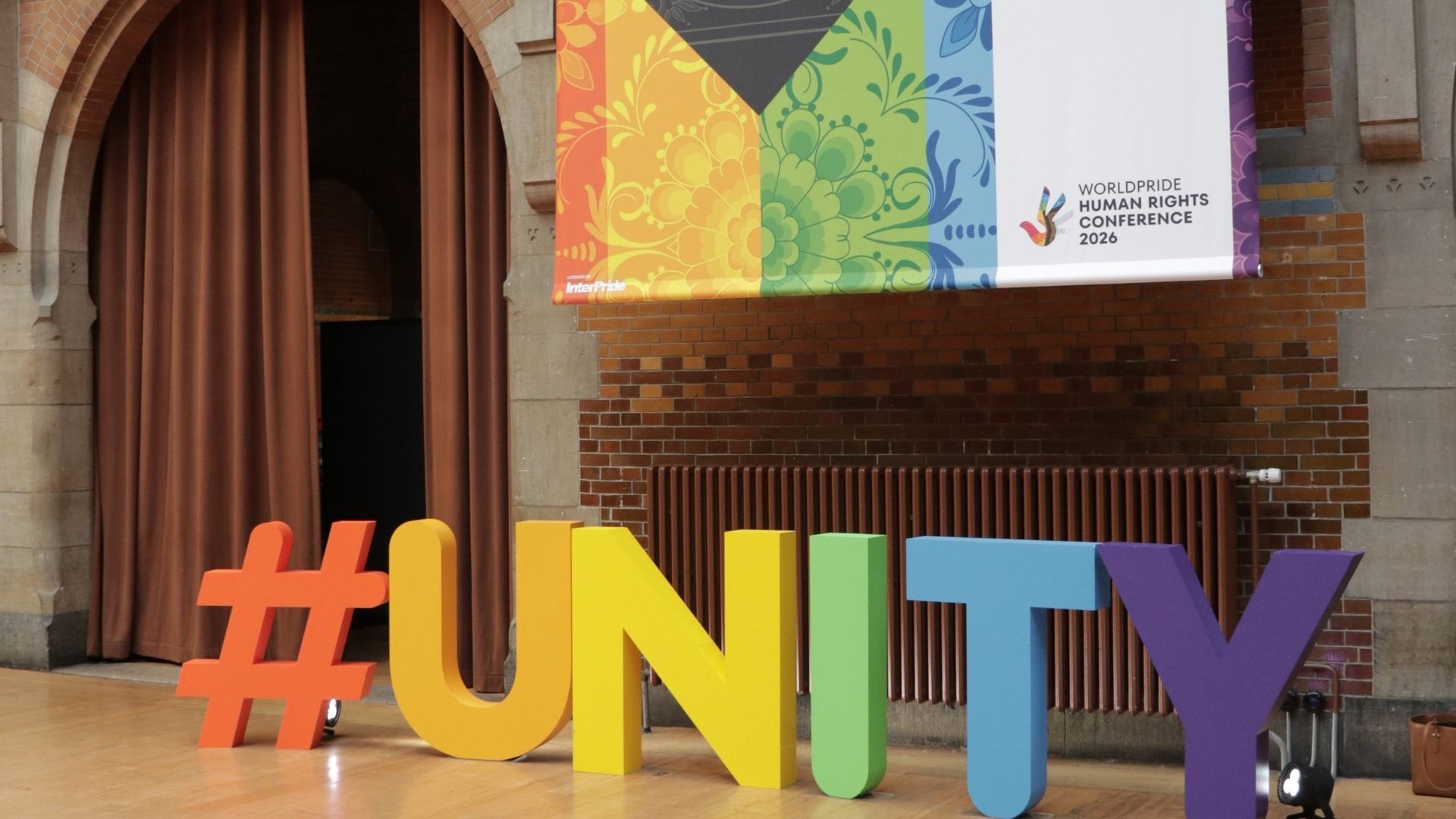
WorldPride Human Rights Conference 2026 in Amsterdam. Photograph: Beza Lealem.
In our August round-up of LGBTQ+ news, Fatteh spotlights the Amsterdam conference where activists from across Africa joined a thousand international delegates to advance equal rights and strengthen global solidarity.
by Beza Lealem
For several days in August, LGBTQ+ activists, human rights defenders, politicians, funders and community leaders from around the world gathered in Amsterdam for the WorldPride Human Rights Conference. Among them were African delegates who brought varied experiences from a region where some LGBTQ movements have secured hard-won gains despite increasingly organised opposition. For younger activists, the very act of being there affirmed that “advocacy has no borders,” as Rwanda’s Hertier Hatangimana later said.
African perspectives featured across the conference programme. Participants from the continent contributed to discussions on political leadership, health, faith, forced displacement and how to build sustainable LGBTQ organisations and networks. A session called ‘Fighting Erasure’ explored how social, cultural and religious conservatism, together with the legacy of colonialism, has obscured LGBTQ African histories — and what can be done to restore them.
Who gets to record that history matters too. “Information is power,” stressed conference attendee John Matenge of Kenyan advocacy HOYMAS, pointing to independent media’s role in countering misinformation and stereotypes. In his session, filmmaker Mathendu Muchoki of Bold Network Africa similarly highlighted the importance of LGBTQ Africans documenting their own lives, citing a film about trans women in 1990s Côte d’Ivoire as an early example of how storytelling can change perceptions on the continent.
Those discussions fed into a broader debate at the conference. Fatteh’s conversations with delegates kept returning to three big questions: who sets the priorities for African LGBTQ movements, what meaningful international solidarity looks like and how the people doing the work can sustain it. For Sandra Nafula, executive coordinator of Nigeria-based African Queer Youth Initiative (AQYI), the answer to all three lies in listening to those closest to the issues.
“Resources, attention and focus should actually go to the members of the community that need it,” Nafula argued.
Whose voices carry weight?
But change often requires people in power to act. That need for high-level backing made the presence of African political leaders at WorldPride particularly significant, including South African Member of Parliament and Deputy Minister Mmapaseka Steve Letsike, Zimbabwean MP Daniel Molokele, Lesotho’s Deputy Speaker of Parliament Ts’epang Ts’ita-Mosena, and Seychelles opposition leader Bernard Georges.
They were part of a much broader African presence: more than two dozen speakers from the continent contributed to the conference programme, most of them activists and practitioners.
Bringing these African voices into a global gathering of a thousand delegates and hundreds of speakers was a hard-earned achievement — one that’s commendable and worth building on. Yet the scale of African participation must be viewed alongside the continent’s outsized stake in the conversations at WorldPride: half of the 66 countries worldwide that criminalise consensual same-sex relations are on the continent.
Across those 33 African countries, around 1.2 billion people — roughly three-quarters of the continent’s population — live under criminalisation, with punishments ranging from prison sentences to the death penalty and laws that fuel a wider climate of stigma, discrimination, persecution and violence. In other words, criminalising LGBTQ people remains the norm rather than the exception in Africa, affecting a clear majority of the continent’s 54 countries.
Against that sobering backdrop, the question is not simply who is represented at global gatherings like this one, but who remains absent — and what more can be done to bring more African voices into the room, particularly those from communities facing the greatest risks and the steepest barriers to being heard internationally?
According to Nafula, the composition of the conference demonstrated that “there is a lot of work that needs to be done” to ensure different African countries and identities are “properly” represented, with people able to speak about their experiences for themselves. While she was encouraged to see young LGBTQ people from the Global South “standing to be counted”, she said visa and travel barriers still make it “extremely hard to be able to access” overseas gatherings and sometimes prevent Africans from reaching them at all.
Other delegates noted the more modest presence of Francophone, Lusophone and Arabic-speaking Africa in the programme compared with English-speaking countries. The absence of Ethiopia, the continent’s second most populous country, was another issue. Such gaps matter because barriers to participation affect more than who gets to attend a conference. They can also shape whose experiences are heard in the international spaces where priorities, partnerships and support are discussed.
For some attendees, that raised broader questions. Muchoki said he left Amsterdam asking whether African advocates need more opportunities to convene closer to home. “As much as it is beautiful to see queer people from all over the world come here, it’s also important for us to create those safe spaces for ourselves on the continent,” he told Fatteh, arguing for gatherings that are more accessible and “resonate” strongly with LGBTQ Africans.
One step in that direction is already on the horizon. At WorldPride’s closing ceremony in Amsterdam, the mantle passed from the Netherlands to South Africa, with Cape Town set to host the next event in 2028. The city’s selection by InterPride, the global Pride network behind the event series, marks a historic first for Africa — and will bring the Human Rights Conference to the continent too.
The significance of that milestone is underscored by the challenges that confront Africa’s LGBTQ movements. Across the continent, advocates are facing harsher restrictions on their ability to organise as campaigns opposing LGBTQ rights become increasingly coordinated.
Speaking during the conference’s ‘Diplomacy in Action’ session, South Africa’s Mmapaseka Steve Letsike warned that the backlash against LGBTQ people is increasingly organised across borders, moving “legal templates, money, narratives and digital content” between countries. In practice, this allows hateful messaging, anti-rights campaign tactics and strategies to be replicated, making cooperation between human rights defenders even more important.
“We must answer this [opposition] with a diplomacy that is equally organised,” said Letsike, an openly lesbian activist who made the transition from civil society to parliament in 2024, some 18 years after South Africa became the first African country to legalise same-sex marriage — and the only one to have done so to date.
Progress can be reversed
African delegates shared different examples of progress being made at home. In Kenya, Njeri Gateru of the National Gay and Lesbian Human Rights Commission (NGLHRC), pointed to years of strategic litigation that have expanded the rights recognised by Kenyan courts — even as same-sex relations remain criminalised in the country. “The question no longer is about identity and existence,” she told Fatteh. “It’s about what that existence entitles you to as a Kenyan.”
Matenge, executive director of HOYMAS (Health Options for Young Men on HIV/AIDS & STIs) offered another example of how organisations can navigate environments where explicit LGBTQ rights advocacy meets resistance. “There is always an entry point. Our entry point is health,” he said, cautioning that change takes time.
That search for an entry point is also central to the work of the diplomats attending the conference. Lord Collins of Highbury, the UK’s Special Envoy on LGBT+ Rights, described a similar approach built around dialogue and partnership with governments, including in countries where a direct conversation about LGBTQ rights might otherwise be rejected.
Drawing on his previous role as the UK’s Minister for Africa, Collins said he would begin by understanding governments’ priorities, including issues such as economic growth, and use that broader relationship to create space for conversations about inclusion and human rights. “If I simply said I want to talk to you about LGBT rights, they just simply wouldn’t listen,” he recalled, citing his engagement with leaders across the continent, including Uganda’s President Yoweri Museveni.
Collins said his experience in Africa had also shown him how important activists and organisations outside government are in supporting communities and holding those in power to account. He called a “vibrant civil society” one of the most important ingredients of a healthy democracy. “Without that,” he said, “progress is always vulnerable to being pushed back.”
His point also raises a different question: who supports the people doing that work? For African LGBTQ activists, including many interviewed by Fatteh at the conference, exhaustion and burnout are increasingly threatening their ability to continue.
Investing in frontline activists
African LGBTQ organisations are responding to legal threats, community crises, funding losses, political hostility and misinformation, often with limited resources. Yet Gateru argues that funding models can overlook what keeps those organisations functioning: the activists themselves.
“We must invest in the people who are doing the work,” she said, noting that some funding models recognise projects and outputs without sufficiently recognising “the humanity behind the work, the need for rest, the need for care, the need for support”.
That support is especially important across a continent where hostility towards LGBTQ people leaves many activists particularly vulnerable because of the work they do. When risks and pressures force highly visible activists to go into exile or relocate to another country, Gateru added, movements can lose not only individuals but also their experience, institutional memory and ability to mentor those coming behind them.
For Ugandan trans-rights activist Aggie Dennett Harmon, a winner of one of this year’s International Pride Awards, another strain for people doing work like hers comes from absorbing the distress and traumatic experiences of those they support.
“How do you heal?” she asked fellow activists. “As human rights defenders who are on the frontline, we’re always hearing people’s stories that [hark] back to our own.”
Her message to funders was equally direct. “As human rights defenders, we are giving without filling our cups,” she said. “If we give and give until our cups are empty, at the end of the day, we’re going to be drained. Who is filling those cups? Survivor-centred healing work has to be funded.”
International solidarity without taking over
Supporting the people doing the work also means trusting them to lead it. That principle ran through conversations about the role governments, funders and international organisations can play without overriding the people they are trying to support.
Speaking on a panel about how international institutions can advance LGBTQ rights, South African scholar Graeme Reid noted that local activists and organisations are usually best placed to understand their country’s politics, determine which approaches might work and judge when intervention from outside could cause harm.
“The greatest opportunities for advancing rights rest with civil society organisations in particular countries,” said Reid, who serves as the United Nations Independent Expert on protection against violence and discrimination based on sexual orientation and gender identity (SOGI), a mandate established by the UN Human Rights Council.
His fellow panellist Maria Sjödin, executive director of Outright International, a US-based global LGBTQ human rights group, echoed Reid’s emphasis on locally led approaches. “You can’t parachute right in from the outside,” she told Fatteh. International support, she argued, must begin with communities setting their own priorities and deciding how the work should be done. “Nobody wants to always be spoken for.”
For Julia Ehrt, executive director of Geneva-based advocacy ILGA World, that principle goes to the heart of how progress is made. “Change happens when communities organise,” she said.
Governments providing funding face the same question of how to support rather than dictate local priorities, a concern acknowledged in parts of the UK’s latest funding commitment. In May, the British government pledged £21 million over three years to advance LGBT+ rights internationally. Alongside support for legal reform and people’s right to speak freely, the initiative explicitly backs “locally led” organisations tackling violence and persecution.
Lord Collins said sustainable support means working with partners to understand “what they need, what they want and how they see changes”. He also cautioned against measuring progress only through major legal outcomes such as decriminalisation. “Every step we take should benefit our community and should make people feel safer,” Collins said.
But improving conditions for LGBTQ people is becoming harder as many movements find themselves defending gains already won while pushing for further change. Making that task harder still, the resources available to sustain their work are shrinking.
In his session, Jeffrey O’Malley, then a UN Development Programme senior advisor on LGBTI+ inclusion and team leader for HIV and health in Africa, acknowledged that development funding has fallen sharply, affecting not only LGBTQ work but humanitarian, climate and development programmes more broadly. The response, he argued, cannot simply be to compete harder for diminishing resources.
Instead, O’Malley believes there are opportunities to build broader coalitions around shared threats. Groups attacking LGBTQ rights, he said, frequently also target gender equality, reproductive health and other issues. “We have more allies now on LGBTI+ work than we’ve ever had,” he said, noting that feminist and other organisations targeted by the same movements increasingly have reason to work together.
Nafula of AQYI made the same argument from a grassroots perspective, calling solidarity “not a nice to have” but an integral part of achieving change. Even as shrinking funding creates competition, she said, organisations must still find ways to unite around shared goals.
This year’s WorldPride Human Rights Conference provided a space for those connections to take shape.
Finding a place to refuel
Such gatherings matter, says ILGA’s Ehrt, because global movements need physical spaces where activists can build trust, learn from one another and form relationships that are harder to develop remotely. Bringing people together can be valuable even when there are no simple answers to the complex and diverse challenges they face.
For African delegates, the event offered a chance to strengthen solidarity around common struggles while exchanging strategies informed by different realities at home. For activists carrying the strain of that work, it was also a place to refuel before returning home to continue it.
Fatteh’s Defender of the Month
Each month, Fatteh celebrates people standing up for LGBTQ communities across Africa. Our latest honouree is a Ugandan trans-rights activist and pastor whose work highlights an issue often neglected by the human rights movement: the wellbeing of survivors who help others facing the same kinds of hostility they have endured themselves.
Aggie Dennett Harmon is Fatteh’s Defender of the Month, following her selection as a winner of the 2026 International Pride Awards during the WorldPride Human Rights Conference in Amsterdam. For Harmon, the award affirmed her belief that rebuilding lives through care is not peripheral to LGBTQ activism but essential to sustaining the people who do it.
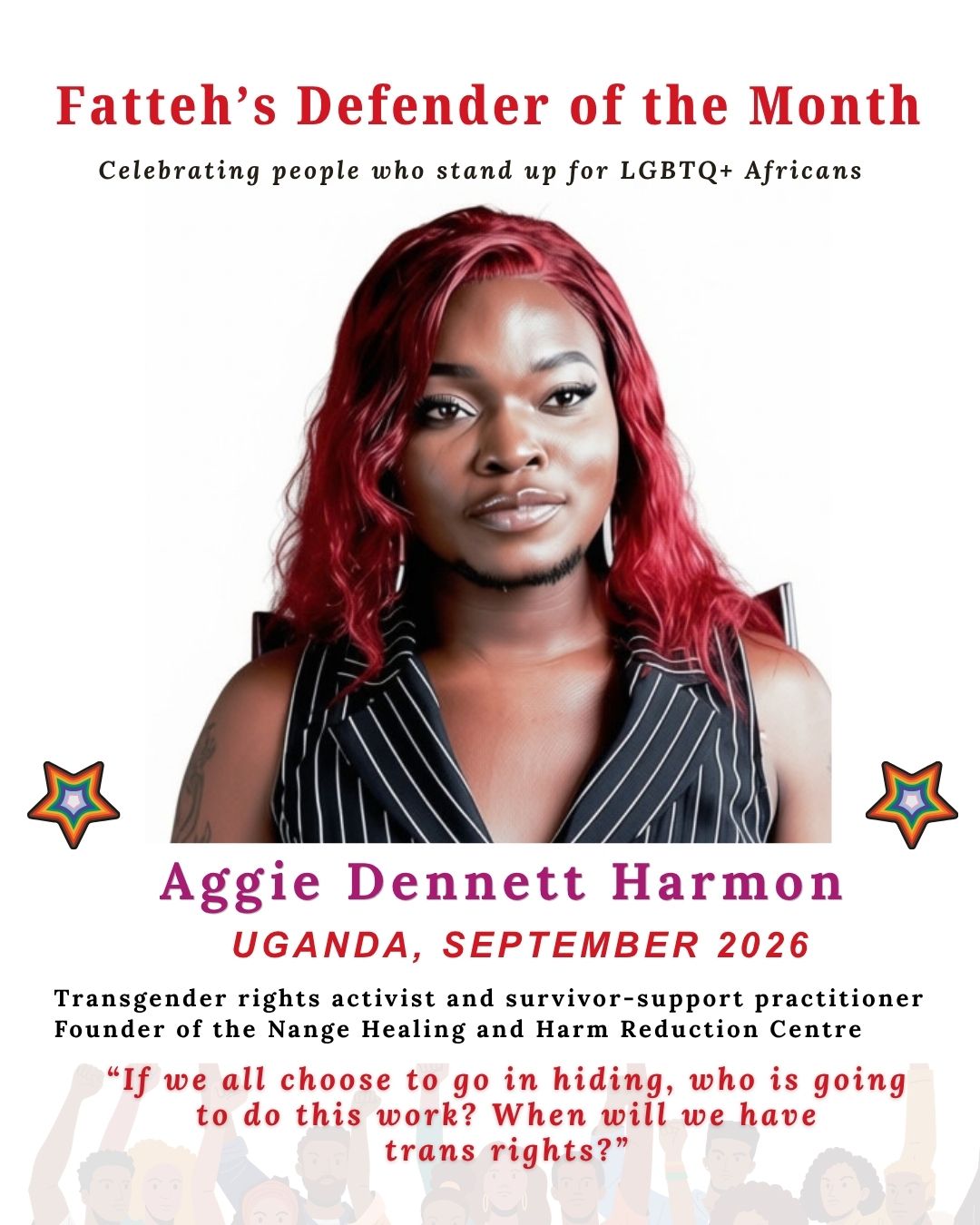
That commitment, together with the unusual candour she brings to her advocacy, led Fatteh to recognise her. Harmon speaks openly about her own history of homelessness and drug use, alongside other stigmatised experiences, to show others that their lives can take a different course. For younger trans people in Africa struggling to imagine a different future, Harmon hopes her journey can demonstrate what is possible.
“This is home now — a place that was built by survivors for survivors,” said Aggie, referring to the Nange Healing and Harm Reduction Centre she founded in Kampala. “It is so hostile here but then the hope of a better world keeps me going. I am very open about this work. If we all choose to go into hiding, who is going to do this work? When will we have trans rights? And gay rights? When will we have liberation?”
More LGBTQ+ news from Africa: August round-up

 Ghana parliament moves to revive sweeping anti-LGBTQ legislation
Ghanaian archbishop reverses position on anti-LGBTQ legislation
 Cape Verde trains teachers to combat LGBTQ prejudice in schools
Ghanaian television commentator publicly supports his transgender child
 More than 70 men arrested in Senegal over alleged same-sex relations
Eight people suspected of being lesbians arrested in Senegal
 Malawi’s youth openly challenge the country’s same-sex relations laws

 Egypt and Tunisia lawyers use ‘rights selectivism’ to target LGBTQ communities

 Ugandan lesbian mothers face hostility in Kenya’s Kakuma refugee camp
 Homophobic Cape Town preacher faces renewed scrutiny in South Africa
 Lesbian refugee from Cameroon wins Commonwealth Games silver for England
 LGBTQ cruise ship draws criticism in Morocco after docking in Tangier
 Angolan LGBTQ and youth groups join forces on sexual and reproductive rights
 Mozambique LGBTQ communities face exclusion despite legal tolerance
Vaal LGBTI Pride is postponed but marks a decade in South Africa
Peter Tatchell Foundation supporters fund LGBTQ safe-house in Uganda
South Africa study exposes gaps in gender-affirming healthcare access