
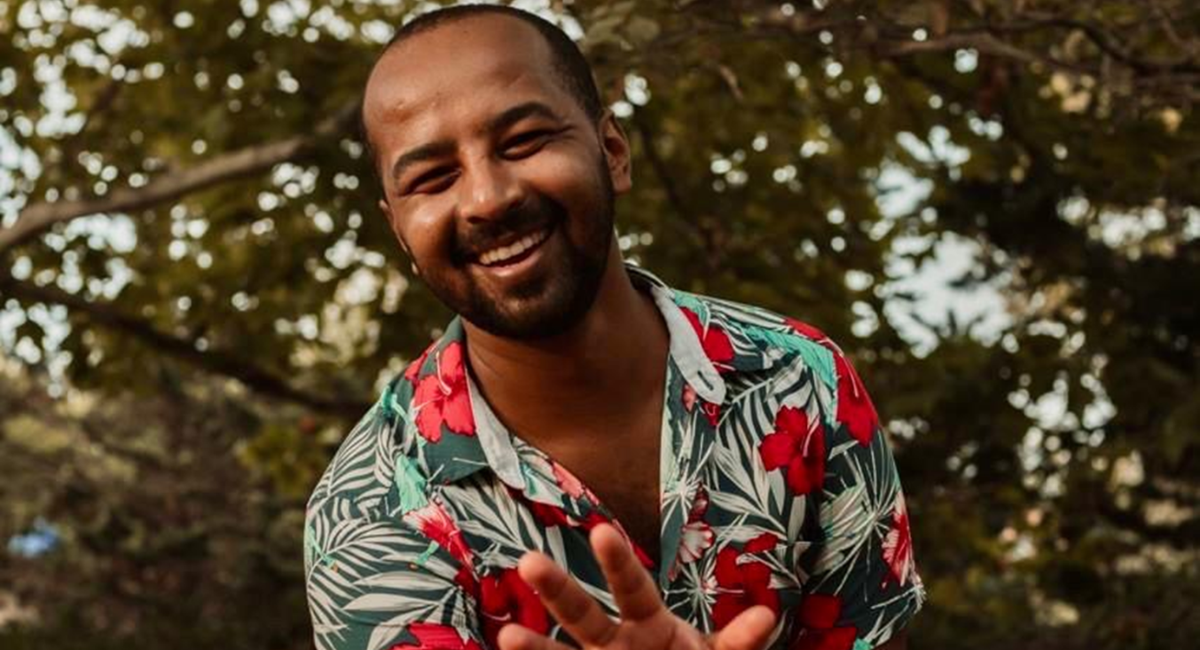
Ethiopian LGBTQ activist Robel Meseret Hailu. Courtesy of Robel Hailu
Robel Meseret Hailu made history as the first Ethiopian contestant in Mr Gay World before helping to launch the advocacy group House of Guramayle, creating a support network for LGBTQ+ people under constant attack.
by Beza Lealem
Wrapped in traditional Ethiopian dress, Robel Hailu carried more than nerves as he stepped onto the Mr Gay World stage. Just 24 at the time of the contest 14 years ago, he bore the weight of a nation that condemned him — and a truth he had spent most of his life learning how to hide. In the seconds before the spotlight hit, Robel closed his eyes and said a prayer.
“I walked onto the stage frightened,” recalls Robel, now in his late 30s, describing the moment in Johannesburg that changed his life forever. Even though it was the first time the pageant had been held in Africa and the first edition to include a contestant from Ethiopia, Robel says he couldn’t enjoy the experience as others might have.
Behind the smiles and camera-ready costumes, nerves ran high as contestants paraded onstage, each wearing a sash emblazoned with his country. Music thundered overhead as smoke machines added to the drama of the gilded theatre. For some, it was stage fright under the gaze of a thousand spectators; for others, the worry lay less in the rowdy crowd than in what might await them back home, from being shunned to losing work. For Robel, the fear ran deeper still.
“I was focused on saving my life,” says Robel, who now lives in exile in the United States. “There were Ethiopians living in South Africa threatening to disrupt the entire event just to harm me. I had to get additional security because of death threats.”
The following morning, his world shifted. With his face splashed across news outlets, Robel made global headlines as one of the first Black Africans to compete in the contest, alongside Namibia’s Wendelinus Hamutenya. While Namibia has since decriminalised homosexuality, Ethiopian law continues to impose lengthy prison terms for same-sex intimacy, emboldening public hostility toward gay people and putting lives at risk, just as it did back then.
“I remember being so worried about what would happen afterwards. Where would I go? How would I live? What would my life look like after the competition?”
In the Eye of the Storm
The Ethiopian media picked up the story within hours, outraged at the very idea of someone professing to be ‘Mr Gay Ethiopia’. His phone was ringing non-stop as messages of hate came pouring in. Though Robel had planned to warn his family, he says he never got the chance. “It all happened so fast.”
The response was as severe as it was swift. Robel’s family disowned him, friends accused him of shaming them, and the church he once served closed its doors to him. Neighbours hurled abuse, while people he grew up with blocked him online. On top of it all, some within the Ethiopian LGBTQ community were also upset, fearing that his participation in the contest might trigger a backlash that would engulf them all.
With the life he knew dissolving within days, it was faith that carried him through. “My spirituality helped me a lot. It was my core,” Robel recalls.
That’s when he returned to the prayer he whispered to himself on stage. At the heart of it was a simple refrain: “I believe God doesn’t make mistakes.” It was a plea for strength, a vow to be true to himself and a quiet act of defiance against those who invoke religion to cast gay people as deviants.
“I stopped asking to be changed and started asking to be protected. There was something inside me saying, ‘tomorrow is another day; you’re not alone; a better day will come’.”
Although many had completely abandoned him, Robel was not alone. The unwavering support of his closest friends, encouragement from his mentor, and access to therapy helped him survive the aftermath. Robel can now see that his bravery made an impact. “Because of the media coverage, at least the Ethiopian public began paying attention to our existence,” he says. “They no longer say we don’t exist; that alone is something.”
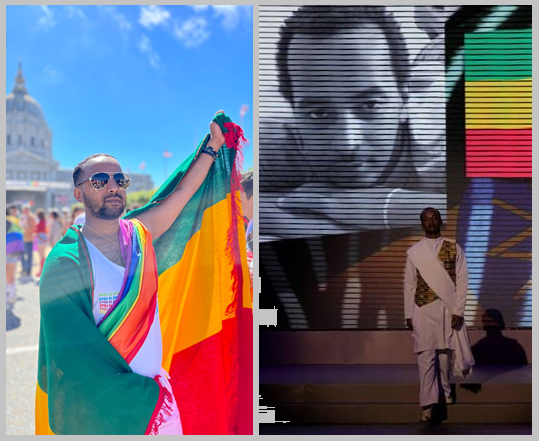
A decade apart: Robel attends San Francisco Pride in 2022 (L) and walks the stage at Mr Gay World in Johannesburg, South Africa, in 2012 (R). Courtesy of Robel Hailu
Until his 2012 contest forced them to face reality, many pretended — in some cases truly believed — that there were no gay people in Ethiopia, in part because no one had dared to put their head above the parapet. When Robel finally did, it forced the media to break a long-standing code of silence that had effectively erased LGBTQ people from the public record.
For Robel, there were personal gains too. “Although I did have to change cities because of the danger to my life, ultimately the competition allowed me to live as my authentic self without suppressing who I am,” he says.
To this day, Robel remains the only Ethiopian to have ever taken part in Mr Gay World. He is also one of the first people born in Ethiopia to have publicly come out as gay, a very small circle that has barely expanded since. The number of Ethiopians worldwide who have publicly come out as LGBTQ is so small, in fact, that they could all probably squeeze into just one blue minibus — the kind of shared taxi anyone who’s navigated Addis Ababa’s crowded streets would instantly recognise.
Even today, Robel still receives messages from people describing how seeing him in the contest helped them accept who they are. “They tell me it helped them come to terms with their sexuality or made them realise they’re not alone. Or simply that you can be Ethiopian and gay,” he says.
By choosing maximum visibility, Robel Hailu made history. Becoming a lightning rod for controversy was an act of courage that came at a heavy personal cost. But it’s what he has done since then — raising awareness, provoking dialogue and standing up for his community with fearless consistency — that makes him a natural choice for Fatteh’s first cover and a fitting voice for LGBTQ History Month.
Seeing Is Believing
After seeking asylum in the United States, Robel went on to rebuild his life. He volunteered with rights organisations like Human Rights Campaign and Asylum Works. He pursued training in political leadership, strengthening his organising and advocacy skills. Online, he created a Facebook page ‘Ethiopian LGBTQ’ to connect with others and form a broader network.
In 2018, those connections deepened, leading him to launch the advocacy group House of Guramayle (HoG) with fellow Ethiopian LGBTQ activists in exile and allies. “Our aim was to create an intersectional platform for advocacy, storytelling and network-building so LGBTQ Ethiopians can get the support they need,” Robel says.
Robel says that he and co-founders Bahiru Shewaye and Faris Cuchi Gezahegn made significant progress “despite the pandemic and shifting political realities,” highlighting HoG’s publication of Tikuer Engda, “a book collecting queer Ethiopian stories,” and its hosting of a virtual Horn of Africa Pride event.
“We also engaged international stakeholders on LGBTQIA+ Ethiopians’ rights issues and established partnerships that help community members to navigate moments of acute risk, including waves of online outings and harassment. I believe we built a foundation that enables us to teach the community and learn from them too.”
Robel’s own storytelling has become central to this work. As host of the Alen Show, first on Instagram and later on TikTok, he speaks in Amharic about everyday experiences, misconceptions and fears. “People listen differently when they hear stories in their own language,” he explains.
The goal, he says, is simple. “To help other ‘baby Robels’ not go through what I did,” and to shine a light on the many invisible LGBTQ Ethiopians, Eritreans and members of the global Habesha diaspora whose lives may feel a little heavy as they struggle with their sexuality or gender identity. Robel invites them to talk openly about their childhood, family, faith, exile, love, fears, hopes and survival stories.
“Silence is no longer an option. When lies about our community are repeated, they start to become the truth [by becoming ingrained in our own understanding of ourselves],” warns Robel, explaining why he keeps showing up on social media, even when it exhausts him. “We have no choice.”
Beyond the interview conversations he leads, Robel breaks down misinformation while responding with calm but firm clarity to homophobes and bigots who all too often try to hijack his online sessions. When challenging dangerous claims about morality, health or the law, he does so patiently and without raising his voice. Sometimes he plays a song in the background, allowing music to say what words cannot.
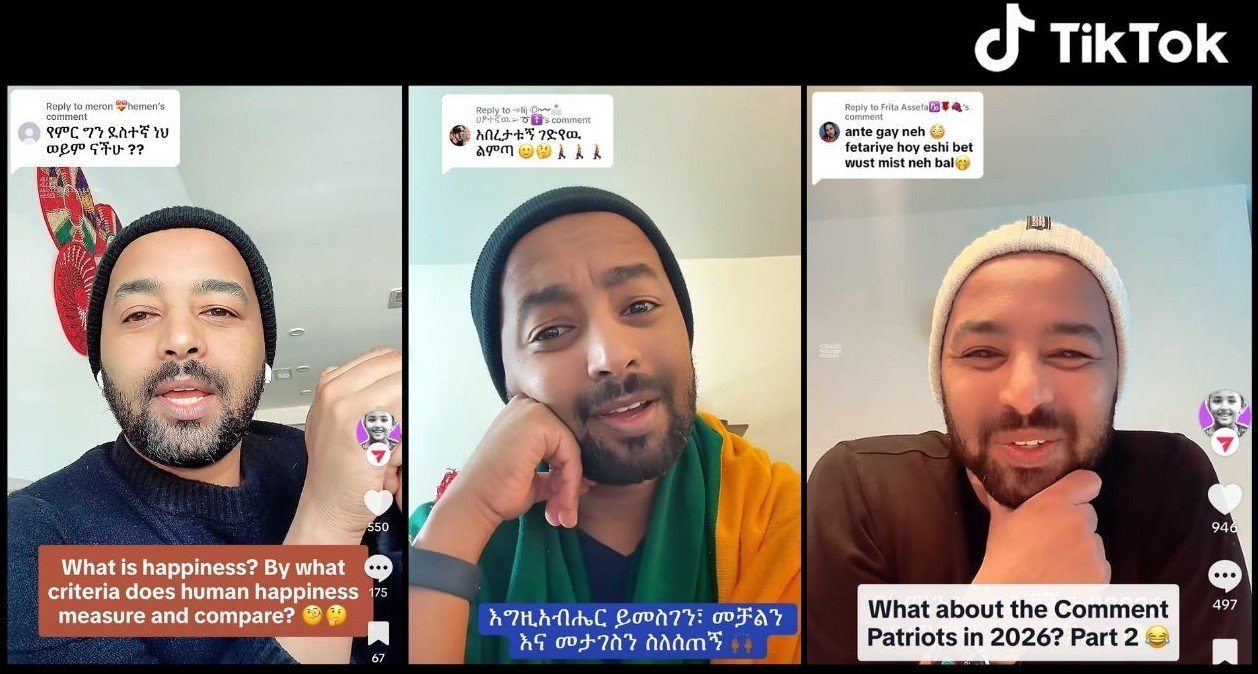
Robel challenges misinformation and responds to hostlity with patience, turning social media comments into moments of learning and reflection.
“I wake up every morning knowing that 120 million Ethiopians hate me. I don’t doubt it. This is my reality,” Robel says plainly. “But I don’t hate them. I believe people hate me because they don’t know my story. That’s why I don’t lose hope in Ethiopians because there is no reason they would hate me this deeply if they really knew me.”
Robel is careful not to overstate the movement’s progress, adding that he expects backlash to grow alongside visibility. “Right now, it feels like we are going one step forward but three steps back,” he says, sharing his worries about anti-LGBTQ propaganda, dehumanising campaigns by political and religious leaders, a spike in violent attacks, shrinking activism resources, and the toll it all takes on LGBTQ people living under constant threat in Ethiopia.
“We have one thing in common. We all need to protect our safety. My safety is not just mine; it is the community’s too,” says Robel, emphasising the importance of encouraging everyone to have a personal security strategy, including digital safeguards.
“However,” he adds, “let’s still make a habit of calling people out and telling them when they are writing or exposing something that is wrong.”
Keeping the Faith
Growing up in Ethiopia, Robel was often told he was ‘different’. “I knew I liked men. I knew I was going to marry a man. But I didn’t know how to put it,” he says. Even as a child, he sensed it clearly enough to joke that he would one day marry his childhood crush, the American singer and songwriter Usher.
From the age of eight, when he started attending the Orthodox church, he often heard stories about the destruction of men who loved men, told through the biblical story of Sodom and Gomorrah. Framed as divine punishment for their abominable sins, these teachings frightened him. “It felt like they were talking about me,” he says. “I started questioning myself, fighting with spirituality and my relationship with the church.”
These experiences became the start of a long, private conversation with God. “I often asked, ‘Why did you make me like this? Why is loving another man a sin?’” Robel recalls. Obeying his parents, he did everything in his power to be an upstanding person, but he understood there was one thing he had no control over.
For a long time, he believed the problem was spiritual. He often went to Ethiopia’s holy water sites, convinced that what he felt was a spirit that could be cleansed. He drank holy water day in and day out, fasting alongside the ritual, bracing himself for whatever transformation might come. Nothing changed. “After all of that,” he says, “I was still the same Robel.”
He then spent his teenage years quietly trying to figure himself out. Around 17, using dial-up internet and his uncle’s Windows 95 computer, Robel researched the word ‘gay’ and read encyclopaedia entries late at night. “It solidified what I was feeling and gave it a name,” he recalls. “It was an eye-opening moment.”
The Seeds of Activism
“I always believed gay rights in Ethiopia needed a fight,” Robel says. Aware of how harshly people are treated because of who they love, and of the risks that come with speaking up, he decided to act.
Robel began by reaching out to LGBTQ organisations in South Africa, the region’s main advocacy hub, explaining how gay people in Ethiopia were being silenced. Robel then requested sexual health resources like condoms — items that remain surprisingly hard to access in Ethiopia to this day — and discreetly distributed them within the local community.
At a time when Ethiopia wasn’t even on the radar for most African LGBTQ advocates, his persistence stood out. Some organisations seemed amused that he was asking for such basic safe-sex materials. A few even demanded proof that he was gay — a request Robel found deeply troubling. But some eventually listened.
“Those early experiences taught me that there’s so much more that needs to be done,” says Robel. “There is no one-size-fits-all advocacy or activism. We have to tailor our approach by placing our own perspective at the centre.”
Robel’s approach was to go bold. When people hear what he went through after appearing on the Mr Gay World stage, they sometimes mistake his daring move for recklessness. If they knew what really motivated him to take part — and put himself on the line so publicly — even his detractors might see things differently.
In 2011, when the announcement for the Mr Gay World contest first appeared online, Robel reached out impulsively to the regional director, eager to learn more after hearing it was coming to Africa. He was told the event was a vehicle to advocate for gay rights through education and public performance, and that Ethiopia had no representation. The director encouraged him to apply twice but Robel declined, knowing the potential risks and feeling uneasy about the attention.
What eventually changed his mind was a tragedy — the loss of a close friend whose family forced him through an exorcism after discovering he was gay, chaining his hands and legs. “I saw his bruises. I listened to the hell he went through,” Robel recalls. After four months, unable to endure the pain, his friend finally shouted to his family, “It left me, I am free of it,” pretending the demon had been cast out by the holy water so he could escape the abuse.
Not long after, Robel learned his friend had taken his own life. “I really didn’t expect people would go this far, especially to their own child,” he says. “The realisation that close friends are dying because of who they love, and no one is talking or doing anything about it, broke my heart.”
His friend’s final message urged Robel to do something, anything, so that others might not meet the same fate. Two weeks later, Robel decided to enter Mr Gay World to do exactly that. “I registered to let people know that gay people exist in Ethiopia and that we don’t have rights,” he says.
Holding Onto Hope
Robel still moves through the world with that same conviction. It lives in the work he does today, in the conversations he holds, and in the way he listens to everyone who turns to him from this vibrant but vulnerable community.
The work of activists like Robel comes at a time when LGBTQ Ethiopians face a growing wave of abuse and violence, when simply being suspected of being gay can carry serious consequences. Robel campaigns with the steadiness of someone who has experienced that reality and whose life has been profoundly shaped by it.
He draws inspiration from South Africa’s history of resistance and reconciliation, particularly Nelson Mandela’s fight against apartheid and discrimination against marginalised communities, a legacy reflected in the rights that LGBTQ people enjoy to this day in that country.
Similarly, Robel envisions a future for Ethiopia where people are respected for their humanity regardless of background, and where sexual and gender minorities are protected alongside people of all ethnicities and religions.
“Our question is basic human rights. It’s not a political agenda that can be compromised. My life can’t be compromised,” Robel insists. “My dignity shouldn’t be questioned or debated.”
As the world reflects on the relationship between the past, present and future during LGBTQ History Month, Robel invites people to turn any feelings of solidarity into action. It’s a time for the relative few who are privileged to be “out and proud” to advocate for “the many around the world who are nowhere near that point,” he says, referring to the 64 countries where LGBTQ people are criminalised, including 32 in Africa, and the many others where they face hostility.
Despite the hidden nature of gay life in countries like Ethiopia, where coming out can carry devastating consequences, “there is still no denying those who came before us who paved the way for us and are still doing so,” Robel says.
“They’re elders, caretakers, quiet organisers and everyday people whose labour kept others alive through moments of fear, isolation and loss. Many of them work discreetly, without recognition, some at the cost of their own safety, and some did not live long enough to see their impact acknowledged. Their histories deserve to be told and archived on our own terms,” says Robel with more than a hint of determination, adding that this kind of history does not disappear simply because it is denied.
But you don’t need to subscribe to a misguided version of history — one that reduces LGBTQ life down to a series of extraordinary feats by a select few — to recognise that Robel’s defiant moment in 2012 was a major milestone. Any fair reading of the past would place him among the trailblazers in the history books.
What makes Robel a real inspiration to the community is not his ‘Mr Gay Ethiopia’ title but something far more grounded: the sentiment behind his Instagram bio where he describes himself as an “Unapologetic Gay Ethiopian”. When asked how he sees his place in the country’s LGBTQ history, Robel pauses before offering one word: “Hopeful,” he says.
Why? “Because I am hopeful that change will come, even when progress feels fragile.”